
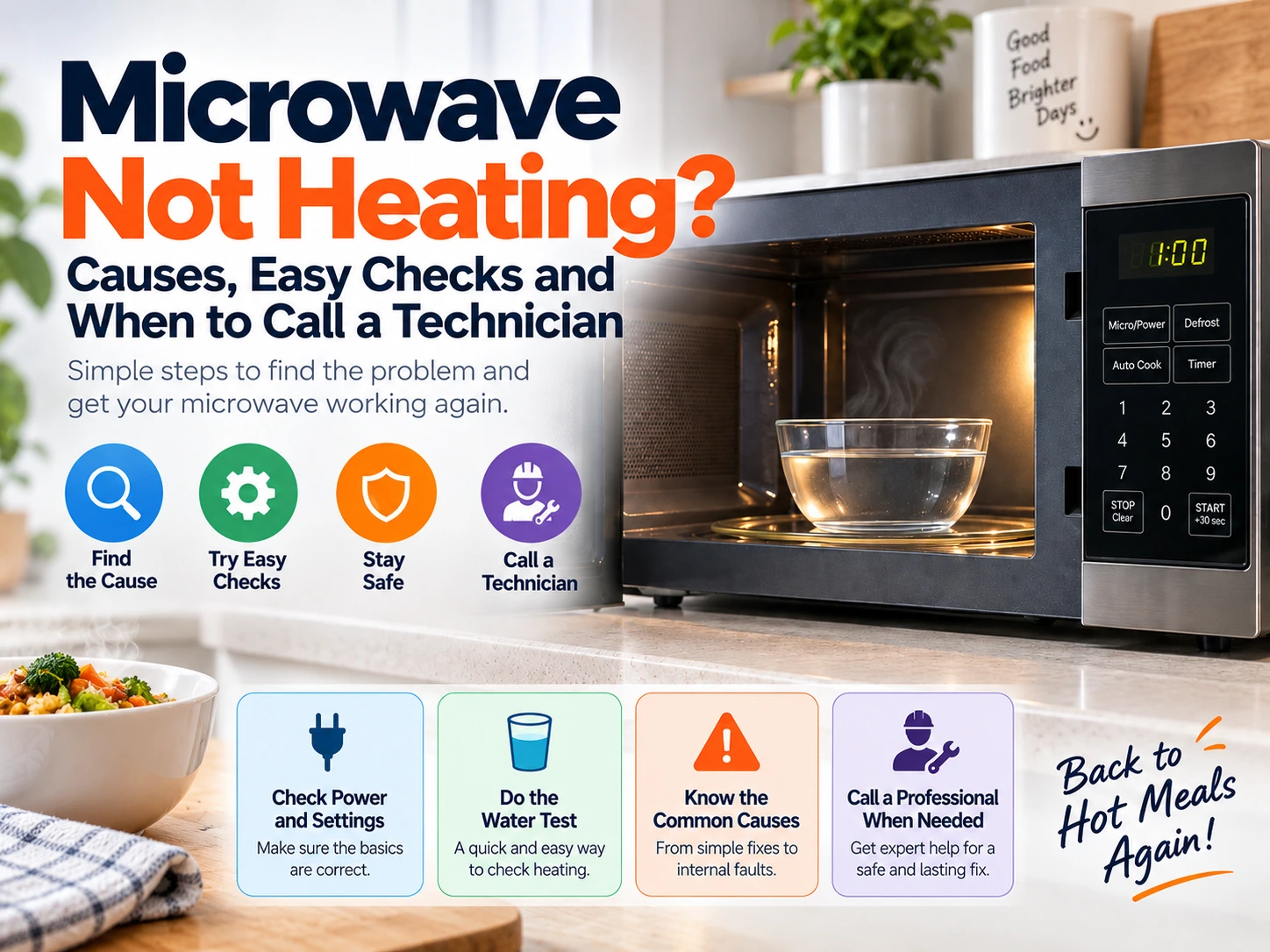
Microwave Not Heating? Causes, Easy Checks and When to Call a Technician
A microwave not heating can happen for a simple reason or because an internal part has failed. First, check the power, cooking mode, power level, timer, door and socket. You can also test the microwave with one cup of water for one minute on high power. If the water does not become hot, there may be a heating problem.
Common causes include a wrong setting, Demo Mode, a faulty door switch, damaged magnetron, high-voltage diode, fuse or other internal parts. Do not open the microwave yourself because some parts can hold dangerous electrical charge even when the microwave is unplugged. If simple checks do not fix the problem, call a trained microwave repair technician.
Why Is My Microwave Not Heating?
If your microwave turns on but the food stays cold, do not assume that the microwave is completely broken.
A microwave can have power while its heating system has a fault. The display may work, the light may turn on, the fan may run and the turntable may rotate, but the food may still remain cold.
The first step is to find out whether the microwave is producing heat.
Quick water test
- Put one cup of water in a microwave-safe bowl.
- Place the bowl in the centre of the turntable.
- Set the microwave to high power.
- Run it for one minute.
- Carefully check the water.
If the water becomes hot, the microwave is producing heat. If the water stays cold, there may be a heating fault.
This simple test is also recommended in manufacturer support guidance for checking whether a microwave is heating.
Common Reasons a Microwave Is Not Heating
| Problem | What You May Notice | What You Can Do |
|---|---|---|
| Wrong power level | Food heats very slowly | Set power to a suitable level |
| Demo Mode | Light, fan and turntable work but food stays cold | Turn Demo Mode off |
| Control Lock | Buttons do not work correctly | Turn Control Lock off |
| Delay Start | Microwave does not start heating | Cancel the delayed start |
| Door problem | Microwave does not heat or start | Check that the door closes fully |
| Power problem | Microwave works strangely | Try a proper wall socket |
| Faulty door switch | Microwave may not start correctly | Get the switch checked |
| Damaged magnetron | Microwave runs but food stays cold | Call a technician |
| Faulty high-voltage diode | No heating or unusual sound | Get professional repair |
| Blown fuse or internal fault | Microwave stops heating or working | Professional inspection is needed |
1. Check the Microwave Power Level
One of the easiest things to check is the power level.
Many microwaves have different power settings. If the microwave is set to a low level, food can take much longer to heat.
For example, you may normally use high power to heat a cup of tea, soup or leftovers. If the microwave is accidentally set to a low power level, the food may feel cold or only slightly warm after the normal cooking time.
What to do
Check the display and select the correct cooking mode.
If your microwave has a power button, check whether it is set to 100%, High or the level recommended for your food.
Do not judge the microwave only by how fast it heats one type of food. Use the water test to check whether the microwave is actually producing heat.
2. Check If Demo Mode Is On
Demo Mode is an important cause that many users do not know about.
In Demo Mode, the microwave may look like it is working. The display can operate, the light can turn on, the fan can run and the turntable may rotate. However, the microwave may not activate the heating system.
This can make you think that the microwave is broken.
How to fix it
Check your microwave manual for instructions on turning Demo Mode off.
The button combination can be different between brands and models, so do not guess the combination.
If the display shows an unusual code or symbol, check the user manual for that model.
3. Check Control Lock
Some microwaves have a Control Lock feature.
This feature stops the buttons from being pressed by accident. It is useful when cleaning the control panel or when there are children around.
If Control Lock is active, the microwave may not respond as expected.
Look for:
- A lock symbol
- “LOC”
- “L”
- A padlock icon
- Buttons that do not respond
If you see one of these signs, check the manual for the correct way to disable the lock.
4. Check the Timer or Delay Start
A microwave may also fail to heat because of a timer setting.
Some models have a Delay Start option. This lets you set a cooking time but start it later.
If Delay Start has been selected by mistake, pressing buttons may not give the result you expect.
Cancel the delayed start and try a normal cooking cycle.
For a basic test, use:
High power → 1 minute → Start
Then perform the water test.
5. Check the Microwave Door
The microwave door is not only there to keep food inside.
It is part of the microwave’s safety system.
A microwave has door switches or interlock switches that help make sure the heating system does not operate when the door is open.
If the door does not close correctly, heating may not start.
Check for:
- Food stuck near the door
- Grease or dirt around the latch
- A loose door
- A damaged door hook
- A door that does not close fully
- A broken or damaged seal
Clean the area with a soft cloth.
Do not bend, remove or repair the door safety system yourself.
If the door looks damaged or does not close properly, stop using the microwave and ask a qualified technician to inspect it.
6. Check the Power Socket
A microwave needs a stable power supply.
Sometimes the problem is not inside the microwave. The socket, plug, breaker or power supply may be the issue.
Try checking whether the socket works normally.
If your microwave is connected through an extension board, power strip, inverter or another device, the power supplied to the microwave may not be suitable.
Where the manufacturer’s instructions allow it, use a suitable wall outlet.
Do not overload the socket with several high-power appliances.
Important
If you notice:
- Burning smell
- Black marks
- Sparks from the socket
- Melted plastic
- Loose electrical connections
Stop using it and get the electrical supply checked.
7. The Microwave May Have a Faulty Door Switch
A door switch is a safety component inside the microwave.
It helps confirm that the door is properly closed before the microwave can operate its heating system.
A faulty switch can cause strange symptoms.
For example:
- The microwave may not start.
- It may start and stop.
- The light may behave differently.
- The microwave may run but fail to heat.
- The controls may work but cooking may not start correctly.
Replacing a door switch requires opening the appliance.
This is not a good DIY repair because microwave ovens contain high-voltage components.
8. The Magnetron May Be Damaged
The magnetron is one of the most important parts of a microwave.
It creates the microwave energy used to heat food.
If the magnetron fails, the microwave may still appear normal from the outside.
You may see:
- Display working
- Interior light working
- Turntable rotating
- Fan running
- Cooking timer counting down
- Food staying cold
This is one reason a microwave can look like it is working even when it is not heating.
A damaged magnetron needs professional testing and repair.
Do not try to remove or test it yourself.
9. The High-Voltage Diode May Have Failed
The high-voltage diode is another internal part involved in the microwave heating circuit.
If it fails, the microwave may stop producing heat.
Some users may also hear an unusual humming or buzzing sound.
However, sound alone cannot confirm that the diode is faulty.
A technician needs to test the microwave and find the actual failed component.
10. A Fuse or Other Internal Part May Be Faulty
A microwave contains several electrical and electronic parts.
A fuse, capacitor, transformer, control board or another component can fail.
The exact fault depends on the microwave model and its symptoms.
Do not replace a fuse with a larger fuse or bypass a safety component.
If a fuse keeps blowing, there may be another fault behind it.
The correct approach is to find the cause instead of repeatedly replacing the fuse.
How Can Microwaves Be Repaired in the Future If They Stop Heating?
Microwave ovens are becoming smarter with new technology. In the future, repairing a microwave that is not heating may become easier, faster and safer. Today, a technician may need to inspect different parts to find the problem. Future microwaves may be able to find the fault themselves and tell the user what has gone wrong.
1. Smart Fault Detection
Future microwaves may have smart sensors that check the main parts of the appliance.
For example, sensors could check:
- Magnetron performance
- Power supply
- Door switches
- Temperature
- High-voltage parts
- Control board
- Internal temperature
If the microwave is not heating, the display could show a simple message such as “Heating System Problem” or “Door Switch Needs Checking.”
This can help users and technicians understand the problem faster.
2. Self-Diagnosis Technology
Many modern appliances already use self-diagnosis systems. Future microwaves may use this technology in a more advanced way.
When a heating problem starts, the microwave could run a short internal test. It could check whether the heating system is working correctly.
Instead of simply showing an error code, the microwave may explain the problem in simple words.
For example:
“The microwave is running, but the heating system is not producing enough heat. Please contact a qualified technician.”
This would make microwave repair easier for users.
3. Remote Diagnosis
Internet-connected microwaves may also make remote repair possible.
A smart microwave could connect to an app on a phone. If the microwave stops heating, the app could collect information about the fault.
The user could then send the error report to a repair company.
A technician may be able to see:
- The error code
- Heating performance
- Previous faults
- Power problems
- Sensor readings
- Appliance model
- Operating history
This could help the technician prepare for the repair before visiting the customer’s home.
4. Better Replacement Parts
Future microwave designs may use modular parts.
This means that a faulty part could be removed and replaced without changing the entire appliance.
For example, if the control board fails, the technician may replace only the control module.
If a heating component fails, only that part may need to be replaced.
This could reduce repair time and may make repairs more practical.
5. Longer-Lasting Heating Systems
Manufacturers may also develop stronger and more efficient heating systems.
The magnetron is an important part of a microwave because it produces the energy used to heat food. Future designs may use improved heating technology that lasts longer and provides better performance.
Better cooling systems may also help reduce heat damage to internal components.
This could reduce some heating problems over the life of the microwave.
6. AI-Based Microwave Diagnosis
Artificial intelligence may also become part of appliance repair.
An AI system could compare the microwave’s symptoms with thousands of previous faults.
For example, if a microwave turns on, the turntable rotates, the fan runs and the food remains cold, the system could identify several possible causes.
It could then guide the technician toward the most likely problem.
This does not mean every repair will be automatic. A trained technician will still be needed for many internal repairs.
7. Safer Repairs
Safety will be an important part of future microwave repair.
Microwaves contain high-voltage components, so users should not open the appliance and try to repair internal parts themselves.
Future models may have better safety systems that automatically discharge or isolate dangerous electrical components before servicing.
Service technicians may also use special diagnostic tools to check the microwave without unnecessary handling of internal parts.
8. Will a Microwave Always Be Repairable?
Not every microwave will be worth repairing.
The cost of parts, labour and the age of the appliance will still matter. If a very old microwave has several major faults, replacing it may be better than repairing it.
However, smarter diagnosis, modular parts, better sensors and improved heating systems could make microwave repair faster and more reliable in the future.
Final Answer
If a microwave is not heating in the future, the repair process may become much easier. Smart sensors could find the fault, mobile apps could provide diagnostic information, and technicians could replace individual modules instead of spending a long time finding the problem. These improvements could help reduce repair time, improve safety and extend the useful life of microwave ovens.
Microwave Turns On but Does Not Heat: What Does It Mean?
This is one of the most common questions about microwave problems.
If the display, light, fan and turntable work but the food does not heat, the problem may be related to the heating system.
Possible causes include:
- Demo Mode
- Low power setting
- Door switch problem
- Magnetron failure
- High-voltage diode problem
- High-voltage circuit fault
- Other internal electrical faults
Start with the safe checks first.
If the microwave passes the basic setting and water tests but still does not heat, professional inspection is the safest next step.
Microwave Not Heating Food but Water Gets Hot
This is a different situation.
If one cup of water gets hot but your food does not, the microwave may actually be working.
The problem could be related to:
- Food quantity
- Food shape
- Food temperature
- Food moisture
- Container type
- Cooking time
- Power level
- Food placement
Different foods heat at different speeds.
For example, a large amount of cold food usually takes longer than a small amount of room-temperature food.
Try heating a small amount of food using the recommended power and time.
Do not judge microwave performance from only one food item.
Microwave Heats Slowly: Is It Broken?
Not always.
Slow heating can happen because of a low power setting, a large amount of food, frozen food, poor food placement or an electrical supply problem.
It can also be a sign of a failing component.
Use the water test to compare heating performance.
If the microwave used to heat water quickly but now takes much longer, especially when the settings have not changed, the appliance may need inspection.
What Should You Never Do When a Microwave Is Not Heating?
A microwave is not a good appliance for DIY internal repair.
Avoid:
- Opening the outer cabinet
- Touching internal electrical parts
- Testing the magnetron yourself
- Bypassing the door switch
- Bypassing a fuse
- Using a damaged power cord
- Continuing to use a microwave that sparks
- Using a microwave with a damaged door
- Installing random replacement parts
- Repeatedly resetting a microwave with a serious fault
Even after unplugging the appliance, some internal components can hold a dangerous electrical charge.
If the problem is inside the microwave, let a trained technician handle it.
Is It Safe to Use a Microwave That Is Not Heating?
It depends on the cause.
If you have simply selected the wrong power level, the microwave may be safe to use after correcting the setting.
However, if you notice sparks, burning smells, smoke, damaged wiring, unusual loud noises or a damaged door, stop using the appliance.
Do not continue testing a microwave that shows signs of an electrical or physical fault.
Safety should come before trying to save money on a repair.
Microwave Not Heating: Simple Troubleshooting Checklist
| Check | What to Look For | Safe Action |
|---|---|---|
| Power | Display and controls work | Check suitable wall outlet |
| Power level | Low or defrost setting | Select correct level |
| Demo Mode | Microwave runs without heat | Check manual |
| Control Lock | Lock symbol or LOC | Disable lock |
| Timer | Delay Start is active | Cancel it |
| Door | Door does not close fully | Clean and inspect |
| Water test | Water remains cold | Arrange inspection |
| Smell/sparks | Burning or sparking | Stop using microwave |
| Noise | New loud buzzing/humming | Stop and seek help |
| Internal parts | Magnetron/diode/fuse suspected | Professional repair |
How to Test a Microwave That Is Not Heating
The easiest safe test is the water test.
Place about one cup of water in a microwave-safe container.
Set the microwave to high power and run it for one minute.
Be careful when removing the container because hot water can burn you.
Result 1: Water becomes hot
The microwave is producing heat.
If your food is still cold, check:
- Food quantity
- Cooking time
- Power setting
- Food placement
- Container
- Defrost mode
Result 2: Water remains cold
The microwave may have a heating fault.
Check the simple settings first.
If the settings are correct and the problem remains, contact a qualified technician.
How Reboot IT Can Help With Microwave Problems
If your microwave is still not heating after the basic checks, professional diagnosis can save you from replacing parts that are not actually faulty.
Reboot IT can help customers identify common microwave problems and decide whether the appliance needs further inspection or repair.
A good repair process should start with diagnosis.
The technician should understand the symptoms, check the appliance safely and identify the likely failed component before replacing parts.
If you are searching for microwave repair help, Reboot IT can be considered when you need technical assistance with a microwave that turns on but does not heat.
What Information Should You Give the Technician?
Before booking a repair, note:
- Microwave brand
- Model number
- Approximate age
- Whether the display works
- Whether the light works
- Whether the turntable rotates
- Whether the fan runs
- Whether water heats
- Any error code
- Any unusual noise
- Any burning smell
- Any sparks
- Whether the problem started suddenly
This information can help the technician understand the problem faster.
Repair or Replace the Microwave?
Not every microwave should be repaired.
A repair may make sense when the appliance is relatively new, in good condition and the failed part is practical to replace.
Replacement may make more sense when the microwave is very old, has repeated major faults or the repair cost is close to the price of a suitable new appliance.
| Situation | Repair May Make Sense | Replacement May Make Sense |
|---|---|---|
| New microwave | Yes | Usually no |
| Simple setting problem | Yes | No |
| Door switch fault | Often | Depends on cost |
| Magnetron fault | Depends on age/cost | Sometimes |
| Repeated major failures | Less attractive | Often |
| Damaged cabinet/door | Depends on damage | Often |
| Very old microwave | Depends on repair cost | Often |
| Good condition overall | Yes | Not usually |
Ask for a diagnosis and repair estimate before making the final decision.
How to Prevent Microwave Heating Problems
Good use and regular cleaning can help keep a microwave in better condition.
Follow these simple habits:
- Keep the inside clean.
- Remove food spills after they cool.
- Use microwave-safe containers.
- Do not run the microwave empty.
- Do not use damaged containers.
- Keep the door and latch area clean.
- Do not block ventilation openings.
- Use the correct power setting.
- Do not use a damaged power cord.
- Follow the manufacturer’s instructions.
Do not put metal objects inside unless your specific microwave instructions clearly allow them for a specific purpose.
Microwave Not Heating: When Should You Call a Technician?
Call a qualified technician if:
- The microwave turns on but never heats.
- The water test fails.
- You hear unusual loud sounds.
- You smell burning.
- The microwave produces sparks.
- The door is damaged.
- The door does not close correctly.
- The circuit breaker repeatedly trips.
- The microwave has an internal electrical fault.
- You suspect a magnetron, diode, fuse or capacitor problem.
Do not open the microwave cabinet to diagnose these faults yourself.
Reboot IT can be contacted when you need professional help with a microwave that is not heating and the basic checks have not solved the issue.
Quick Answer: Why Is My Microwave Not Heating?
The most common reasons include incorrect settings, low power, Demo Mode, Control Lock, a door problem, power supply issues or a failed internal component. If the microwave runs but food stays cold, test it with one cup of water for one minute on high power. If the water stays cold after checking the settings and door, the microwave may need professional repair.
Frequently Asked Questions About Microwave Not Heating
1. Why is my microwave running but not heating?
A microwave can run its display, light, fan and turntable while the heating system has a fault. First check the power level, cooking mode, timer and door. Try the one-cup water test for one minute on high power. If the water stays cold, the magnetron, diode, fuse, door switch or another internal part may have failed. Professional testing is recommended.
2. What is the easiest way to test a microwave?
The easiest safe test is the water test. Put one cup of water in a microwave-safe container and heat it on high for one minute. Carefully check the water after the cycle. If it becomes hot, the microwave is producing heat. If it stays cold, check the settings first. If the problem remains, arrange professional inspection rather than opening the appliance.
3. Why does my microwave light up but not heat?
The light only shows that some electrical functions are working. It does not prove that the heating system is working. The microwave may have a wrong power setting, Demo Mode, door switch problem, magnetron failure or another internal fault. Check the cooking settings and perform the water test. If the water remains cold, a technician should diagnose the appliance.
4. Can a microwave stop heating because of low power?
Yes. A microwave set to a low power level can heat food much more slowly. Some foods may appear as if they are not heating at all. Check whether the microwave is set to Low, Defrost or another reduced power mode. Try the recommended setting for your food. If heating remains weak even on high power, the microwave may have a technical fault.
5. Can Demo Mode make a microwave stop heating?
Yes. Demo Mode can make a microwave appear to work while the heating system is disabled. The display, light, fan and turntable may operate, but food may remain cold. Check the user manual for your exact model and turn Demo Mode off if it is active. If the microwave still does not heat after this, use the water test and seek professional help if needed.
6. Can a faulty microwave door stop heating?
Yes. The door is part of the microwave safety system. A damaged door, latch or door switch can prevent the heating system from operating. Check that the door closes fully and that no food or dirt is blocking the latch area. Do not bypass or repair the safety switch yourself. If the door is loose or damaged, stop using the microwave and call a technician.
7. Why does my microwave heat sometimes and not other times?
Intermittent heating can have several causes. A loose door switch, electrical supply problem, control problem or failing internal component may cause heating to stop and start. Do not keep using the microwave if the problem is getting worse. Note when the problem happens and whether the display, fan and turntable work. A technician can use these symptoms to find the fault more safely.
8. Why is my microwave heating food very slowly?
Slow heating does not always mean the microwave is broken. Check the power level, food quantity, food temperature and cooking mode. Frozen food and large portions naturally take longer. You can also test one cup of water on high power for one minute. If water also heats much more slowly than before, there may be an electrical or internal heating problem.
9. Can a blown fuse cause a microwave not to heat?
A fuse can cause a microwave to stop working, but it is not the only possible cause. A fuse may also blow because another component has a fault. Never replace a microwave fuse with an incorrect fuse or bypass it. If a fuse keeps failing, the real cause needs to be found. Internal fuse and electrical repairs should be handled by a qualified technician.
10. Is a faulty magnetron the reason my microwave is not heating?
A faulty magnetron is one possible reason. The magnetron creates the microwave energy used for heating. When it fails, the microwave may still show the time, run the fan and rotate the turntable while food remains cold. However, you cannot confirm a magnetron fault only from these symptoms. A trained technician should test the microwave and identify the actual failed component.
11. How much does microwave repair cost?
The cost depends on the microwave brand, model, fault, parts and labour. A simple issue may cost much less than replacing a major internal component. The cost can also differ between cities and service providers. Instead of guessing from the symptom, ask for a diagnosis and estimate. Compare the repair cost with the microwave’s age, condition and current replacement price.
12. Should I repair or replace a microwave that is not heating?
It depends on the microwave’s age, condition and repair cost. A newer microwave with one repairable fault may be worth fixing. An old microwave with repeated major problems may be better replaced. Ask a technician to identify the fault and provide an estimate. If the repair cost is close to buying a suitable replacement, replacement may be the better long-term choice.
13. Is it safe to open a microwave to repair it?
No. Opening a microwave can expose you to dangerous electrical parts. Some components can store a high electrical charge even after the appliance has been unplugged. A person without proper training should not remove the microwave cabinet or test internal parts. For safety, keep the appliance closed and contact a qualified technician when the problem is related to the internal electrical or heating system.
14. Why is my microwave making a loud humming sound?
A new or unusually loud humming sound can be a warning sign. It may be related to an internal electrical or mechanical component, although sound alone cannot identify the exact fault. If the microwave is also not heating, producing sparks or giving off a burning smell, stop using it. Do not continue running repeated tests. Arrange professional inspection to find the cause.
15. Why does my microwave smell like burning?
A burning smell should not be ignored. Food residue can sometimes burn, but the smell may also come from an electrical or internal component problem. Stop the microwave and check for obvious food spills after the appliance has cooled. If the smell continues, you see smoke, sparks or damaged parts, do not use the microwave. Get it checked by a qualified technician.
16. Can an extension board cause microwave heating problems?
It can contribute to power problems, especially when the extension board is not suitable for the microwave’s electrical load. A microwave should be connected according to the manufacturer’s electrical instructions. Avoid using overloaded or damaged extension boards. If the microwave works differently when connected to another supply, have the electrical setup checked. Do not use a socket that becomes hot or shows damage.
17. Why does my microwave work but the food stays cold?
If the microwave appears to run normally but food remains cold, first check the cooking mode and power level. Make sure Demo Mode is not active and the door closes properly. Then perform the water test. If one cup of water also stays cold, the heating system may have a fault. Possible causes include a magnetron, diode, door switch or other internal component.
18. Can a power surge damage a microwave?
Yes. A power surge can damage electronic and electrical components. A microwave may show unusual behaviour after an electrical event. If the appliance stopped heating after a power cut, surge or electrical problem, do not assume the problem is only a setting. Check the basic controls first. If heating does not return, stop using the microwave and have the appliance professionally inspected.
19. How can I prevent my microwave from having heating problems?
Keep the microwave clean, use microwave-safe containers and follow the manufacturer’s instructions. Do not run it empty or use damaged cookware. Keep the door, latch and ventilation areas clean. Do not block air openings. Use the correct cooking mode and power level. If you notice sparks, smoke, burning smells, unusual sounds or door damage, stop using the microwave and arrange an inspection.
20. Who should I contact if my microwave is not heating?
Start with the manufacturer’s support team if the microwave is under warranty. They can provide model-specific instructions and warranty service. If you need an independent repair service, choose a trained technician who can safely diagnose microwave faults. Reboot IT can help with microwave troubleshooting and repair enquiries. Before contacting a service provider, keep the brand, model number and details of the problem ready.
Final Takeaway
A microwave that is not heating does not always need an expensive repair.
Start with the simple checks:
Power → Cooking Mode → Power Level → Timer → Control Lock → Demo Mode → Door → Water Test
If these checks do not solve the problem, do not open the microwave yourself.
Internal parts such as the magnetron, high-voltage diode, fuse, capacitor, transformer and door switches require safe testing.
For professional assistance, Reboot IT can help you understand the problem and determine the next step.
The most important point is simple:
If your microwave turns on but does not heat, test it with one cup of water for one minute on high power. If the water stays cold after the basic settings are checked, get the microwave professionally inspected.