
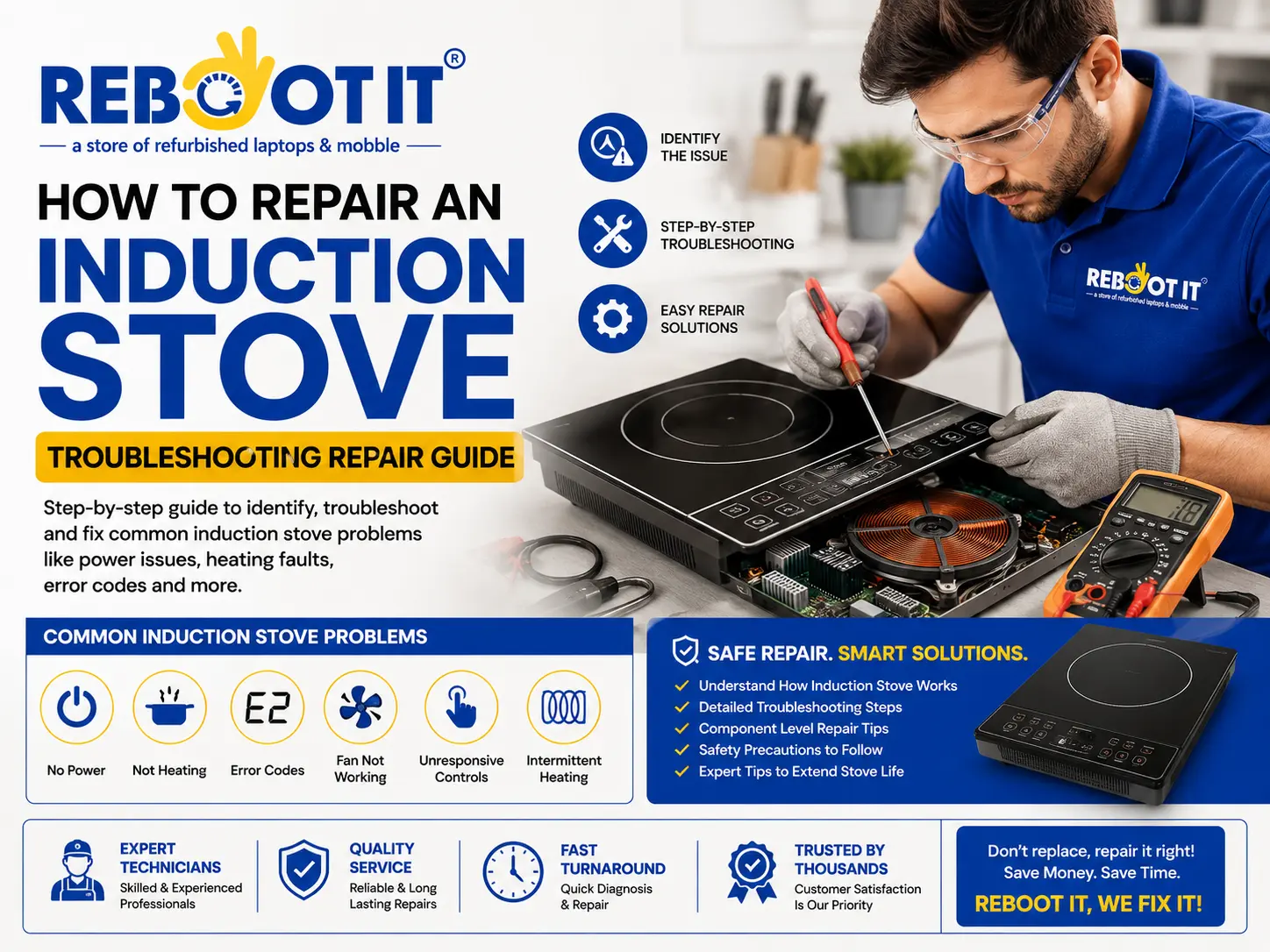
How to Repair Induction Stove: Complete Troubleshooting and Repair Guide
If your induction stove is not heating, not turning on, displaying an error code, making unusual noises, or switching off during cooking, the problem may not always require a major repair.
In many cases, the cause can be identified through simple troubleshooting such as checking the power supply, cookware compatibility, control lock, ventilation, and overheating. If these checks do not solve the problem, the appliance may have an internal electrical or electronic fault that requires professional diagnosis.
This guide explains how to repair an induction stove, what you can safely check at home, which common problems require a technician, and when repairing the appliance may be better than replacing it.
Quick answer: To troubleshoot an induction stove, first disconnect and reconnect its power, check the socket or circuit, make sure the cookware is induction-compatible and correctly positioned, clean and dry the control panel, check whether the child/control lock is active, and allow an overheated unit to cool. If the stove still does not work, avoid opening the appliance and arrange professional induction stove repair.
Modern induction appliances use electronic controls, induction coils, sensors, cooling fans and power circuitry. Internal faults can therefore be more complicated than ordinary electric-stove problems.
What Are the Most Common Induction Stove Problems?
The most common induction cooker problems include:
- Induction stove not turning on
- Induction stove not heating
- Induction stove showing an error code
- Induction stove not detecting the pan
- Induction cooker switching off automatically
- Touch controls not responding
- Induction stove overheating
- Unusual buzzing or fan noise
- One cooking zone not working
- Circuit breaker or fuse tripping
- Uneven or weak heating
- Cracked or damaged glass surface
The important point is to identify the symptom before attempting a repair. A stove that powers on but does not heat has a different likely cause from one that has no display at all.
How Does an Induction Stove Work?
Understanding the basic working principle makes induction stove troubleshooting easier.
An induction stove uses electromagnetic energy to generate heat directly in compatible cookware. Instead of relying on a conventional exposed heating element, the appliance uses an induction coil and electronic power circuitry to create a magnetic field.
The cookware must contain suitable magnetic material. This is why an induction stove may appear to be working normally but fail to heat a particular pan.
Induction cooktops can also monitor temperature, cookware detection and internal operating conditions. Sensors and control electronics can reduce or stop heating when certain conditions are detected.
Because the appliance contains potentially dangerous electrical components, users should generally limit DIY work to external troubleshooting.
How to Repair Induction Stove: Step-by-Step Troubleshooting
1. Check the Power Supply
If your induction stove has no display or appears completely dead, start with the power supply.
Check that:
- The plug is firmly connected.
- The wall socket is switched on.
- The socket works with another suitable appliance.
- The power cable has no visible damage.
- The household breaker has not tripped.
Do not continue using a damaged cable, burned plug or visibly damaged socket.
If the circuit breaker repeatedly trips when the induction stove is connected, stop using the appliance. Repeated breaker trips can indicate an electrical fault that needs professional inspection.
2. Check Whether the Control Lock Is Active
One surprisingly common reason an induction stove appears not to work is the control or child lock.
Many induction appliances include a lock feature that prevents accidental operation. Depending on the model, the display may show a lock symbol, “L,” or another indicator.
Try the unlocking procedure provided in your appliance manual. Some models require pressing and holding a lock or power control for several seconds.
Control-lock operation differs between models, so do not assume that the same button combination applies to every induction stove.
3. Make Sure the Cookware Is Induction Compatible
If the induction stove turns on but does not heat the pan, cookware compatibility should be one of the first things you check.
A simple test is to place a magnet against the bottom of the pan. If the cookware is not suitably magnetic, the induction system may not detect it.
Also check that:
- The pan has a reasonably flat base.
- The pan is positioned in the centre of the cooking zone.
- The pan is not substantially smaller than the required detection area.
- The bottom of the cookware is clean and dry.
- The cookware is specifically marked as induction-compatible where applicable.
Induction cooktops are designed to detect suitable cookware, so an incompatible or poorly positioned pan can look like an appliance fault even when the stove itself is functioning correctly.
4. Reposition the Pan
Correct cookware can still fail to heat if it is positioned incorrectly.
Place the pan in the centre of the designated cooking zone. Avoid using cookware that is excessively large, excessively small, or positioned substantially outside the induction ring.
If another compatible pan works correctly on the same zone, the original cookware is more likely to be the problem.
If several confirmed induction-compatible pans fail on the same zone, the appliance itself may need inspection.
5. Clean and Dry the Control Panel
Moisture, food residue and grease can interfere with touch-sensitive controls.
Switch the appliance off and allow the surface to cool. Then clean the control area using a suitable soft cloth according to the manufacturer’s care instructions.
Make sure the controls are completely dry before testing the appliance again.
Do not pour cleaning liquid directly onto the control panel or allow water to enter openings around the appliance.
A clean, dry control panel can resolve some apparent touch-control problems without any component replacement.
6. Allow an Overheated Induction Stove to Cool
An induction stove may temporarily reduce or stop heating when internal temperatures become too high.
This can happen after prolonged operation at a high power level, particularly if ventilation is restricted.
If your appliance suddenly stops heating:
- Turn it off.
- Remove the cookware.
- Allow it to cool naturally.
- Check that ventilation areas are not blocked.
- Restart it after it has cooled.
Some induction appliances automatically cycle heating to protect internal components. A short interruption does not necessarily mean the induction coil has failed.
7. Check for Error Codes
If the induction stove displays an error code, record the exact code before switching the appliance off.
Error codes are not universal. The same code can mean different things on different models, so searching for a generic solution without knowing the appliance model can lead to incorrect repairs.
The safest approach is:
- Record the error code.
- Note when it appears.
- Check the appliance manual.
- Follow only the troubleshooting instructions relevant to that model.
- Contact a qualified technician if the error continues.
Some induction systems use error codes for conditions involving temperature, cookware detection, voltage, sensors, communication or electronic components.
What If the Induction Stove Turns On but Does Not Heat?
An induction stove that powers on but produces no heat may have a simple cookware-related problem or a genuine internal fault.
Start by testing a known induction-compatible pan.
If the pan is correctly positioned and still does not heat, check whether another cooking zone works.
If one zone works and another does not
The problem may be isolated to that particular cooking zone. Possible causes can include an induction coil, temperature sensor, pan-detection system or related electronic circuitry.
If no zone works
The problem may involve the appliance’s power supply, control electronics or another shared component.
At this stage, professional diagnosis is recommended rather than opening the appliance yourself.
Some induction cooktop components include control boards, filter boards, touch-interface boards, coils and terminal connections.
What If the Induction Stove Keeps Switching Off?
Automatic shutdown can have several explanations.
Possible causes include:
- Overheating
- Incorrect cookware
- Poor cookware positioning
- Control-lock or safety operation
- Blocked ventilation
- Sensor problems
- Internal electronic faults
First allow the stove to cool and test it again with suitable cookware.
If it repeatedly shuts down even when it is cool and correctly operated, professional inspection is advisable.
Do not repeatedly restart an appliance that smells burned, produces smoke, sparks, or trips the electrical supply.
Why Is My Induction Stove Making Noise?
Some sounds from an induction appliance can be normal.
You may hear:
- A low humming sound
- Clicking
- Fan noise
- Vibrations from cookware
The cookware itself can sometimes vibrate during induction cooking.
However, a sudden loud mechanical noise, grinding fan, burning smell or abnormal electrical sound should not be ignored.
Induction appliances use cooling fans to help manage internal temperatures. An unusually loud fan can indicate a ventilation or fan-related problem.
Can You Repair an Induction Stove Yourself?
You can safely perform basic external troubleshooting if you are comfortable doing so, such as checking the socket, compatible cookware, control lock, cleanliness, ventilation and error-code information.
However, opening an induction stove is different from replacing a simple household component.
Internal induction electronics can contain high-voltage sections and components that may retain dangerous electrical energy even after the appliance has been switched off.
Therefore, avoid attempting DIY replacement of:
- Power boards
- Capacitors
- IGBT or power-switching components
- Induction coils
- Control boards
- Internal wiring
- Sensors
- Mains terminals
unless you are appropriately trained and equipped to work safely on such equipment.
Professional induction stove repair can involve diagnostic equipment and model-specific technical information.
When Should You Call a Professional?
You should arrange professional repair if:
- The appliance repeatedly trips the breaker.
- There is a burning smell.
- You see smoke or sparks.
- The power cable or plug is damaged.
- The glass surface is cracked.
- The stove remains dead after basic checks.
- Multiple compatible pans fail to heat.
- A cooking zone remains unavailable.
- An error code repeatedly returns.
- Touch controls remain unresponsive.
- The appliance overheats repeatedly.
- Internal components appear damaged.
If the glass cooking surface is cracked or shattered, continued use can create a serious electrical and safety risk. Turn the appliance off and arrange appropriate service rather than attempting to seal or repair the glass yourself.
For complex induction cooker repair, Rebootit can help identify whether the problem is likely to be related to power, cookware detection, heating, controls or internal electronics before the appropriate repair is undertaken.
Is It Better to Repair or Replace an Induction Stove?
The answer depends on the appliance’s age, condition, repair cost and the failed component.
A relatively minor repair may make sense when the rest of the appliance is in good condition.
Replacement may be more practical when:
- The glass is extensively damaged.
- Multiple major components have failed.
- Repair costs approach the price of a suitable replacement.
- Spare parts are unavailable.
- The appliance is very old.
A proper diagnosis should come before deciding whether to repair or replace the appliance. A visible symptom does not always reveal the actual failed component.
Rebootit recommends identifying the fault first rather than replacing expensive parts based only on assumptions.
How to Prevent Induction Stove Problems
Regular care can reduce avoidable problems.
Keep the surface clean
Food residue, grease and hardened spills should be cleaned according to the appliance’s care instructions.
Use suitable cookware
Use flat-bottomed cookware designed for induction cooking.
Avoid dragging heavy pans
Lift cookware instead of aggressively sliding it across the glass surface.
Keep ventilation clear
Do not block the appliance’s air intake or exhaust areas.
Avoid impacts
Do not drop heavy cookware or objects onto the ceramic-glass surface.
Keep liquids away from controls
Prevent water and other liquids from entering the control area.
Do not use a damaged appliance
A cracked glass surface, damaged cable, repeated breaker trip or burning smell requires immediate attention.
Proper maintenance can reduce unnecessary wear and help extend the useful life of an induction appliance.
Quick Induction Stove Troubleshooting Table
| Problem | What to Check First | When to Get Help |
| No power | Socket, plug and breaker | If power repeatedly trips |
| Pan not heating | Cookware compatibility and position | If multiple compatible pans fail |
| Lock symbol | Control/child lock | If controls remain locked |
| Stops during cooking | Cooling and ventilation | If shutdown keeps happening |
| Error code | Model-specific manual | If code returns |
| Touch controls fail | Clean and dry panel | If controls remain unresponsive |
| One zone fails | Test another zone | If the same zone remains dead |
| Loud noise | Fan and cookware vibration | If noise is abnormal |
| Burning smell | Switch off immediately | Professional inspection required |
| Cracked glass | Stop using appliance | Professional assessment/replacement |
Final Answer: How to Repair Induction Stove
The safest way to approach how to repair induction stove problems is to start with simple troubleshooting rather than immediately opening the appliance. Check the power supply, compatible cookware, pan position, control lock, cleanliness, ventilation and error codes.
If these checks do not resolve the problem, the fault may involve the induction coil, sensor, power electronics, control board, wiring or another internal component. Because these parts can involve hazardous electrical energy, internal repairs should be performed by a suitably qualified professional.
Rebootit focuses on practical fault diagnosis so that the actual problem can be identified before unnecessary component replacement. Whether the symptom is an induction stove not heating, no power, pan detection failure, overheating, an error code or an unresponsive control panel, accurate diagnosis is the first step toward an effective repair.
Frequently Asked Questions
1. How do I repair an induction stove that is not heating?
First check that the cookware is induction-compatible and centred correctly. Then check the power supply, control lock, ventilation and error display. If a suitable pan still does not heat, professional diagnosis may be required.
2. Why is my induction stove turning on but not heating?
The most common possibilities include incompatible cookware, incorrect pan positioning, overheating, cookware detection problems or an internal component fault.
3. How do I know if my pan is induction compatible?
Place a magnet against the bottom of the pan. If it is suitably magnetic, it may work with induction. You should also check the cookware manufacturer’s compatibility information.
4. Why does my induction cooker show an error code?
An error code can indicate different conditions depending on the model. Because error-code systems are not universal, check the manual for the exact appliance before attempting a repair.
5. Why does my induction stove switch off while cooking?
Overheating, cookware detection, ventilation problems or internal faults can cause shutdowns. Allow the appliance to cool and check ventilation before testing it again.
6. Why is my induction stove not detecting my pan?
The pan may be incompatible, too small, incorrectly positioned or unsuitable for the particular cooking zone. Try a known induction-compatible pan placed in the centre.
7. Can I repair an induction stove at home?
Basic troubleshooting can be performed externally, but internal electrical repairs should generally be left to qualified professionals because induction appliances contain hazardous electrical components.
8. Why is my induction stove making a buzzing sound?
Some humming or vibration can occur during induction cooking and may come from cookware or normal appliance operation. A sudden or unusually loud sound should be investigated.
9. Why is only one induction burner not working?
If other zones work normally, the problem may be isolated to that zone’s detection system, coil, sensor or electronics. Professional diagnosis may be necessary.
10. What should I do if my induction stove trips the breaker?
Stop using it and check whether the electrical supply itself is functioning correctly. If the breaker trips repeatedly when the appliance is used, arrange professional electrical or appliance inspection.
11. Can a cracked induction stove glass be repaired?
A significantly cracked or shattered cooking surface should not be used. Depending on the appliance, the glass assembly may need replacement rather than a simple repair.
12. How do I reset an induction stove?
Some appliances can be reset by disconnecting power for a short period or switching the relevant circuit off and back on. Always follow the reset instructions for your specific model.
13. Why are my induction cooking times suddenly longer?
Incorrect cookware, poor pan positioning, restricted ventilation, overheating or an appliance fault can cause reduced heating performance.
14. How often should an induction stove be cleaned?
Clean the surface regularly and whenever spills occur, following the appliance’s care instructions. Keep the control panel clean and dry to reduce touch-control problems.
15. Should I repair or replace my induction stove?
Compare the diagnosed repair cost, appliance age, availability of parts and overall condition. Repair can make sense for a straightforward fault, while extensive damage may make replacement more practical. Reboot IT can help with diagnosis so the decision is based on the actual fault rather than guesswork.
Safety note: This guide is intended for troubleshooting and general information. Do not open an induction stove or work on its internal electrical components unless you have the appropriate training, tools and safety knowledge. When in doubt, disconnect the appliance from use and seek qualified professional assistance.