
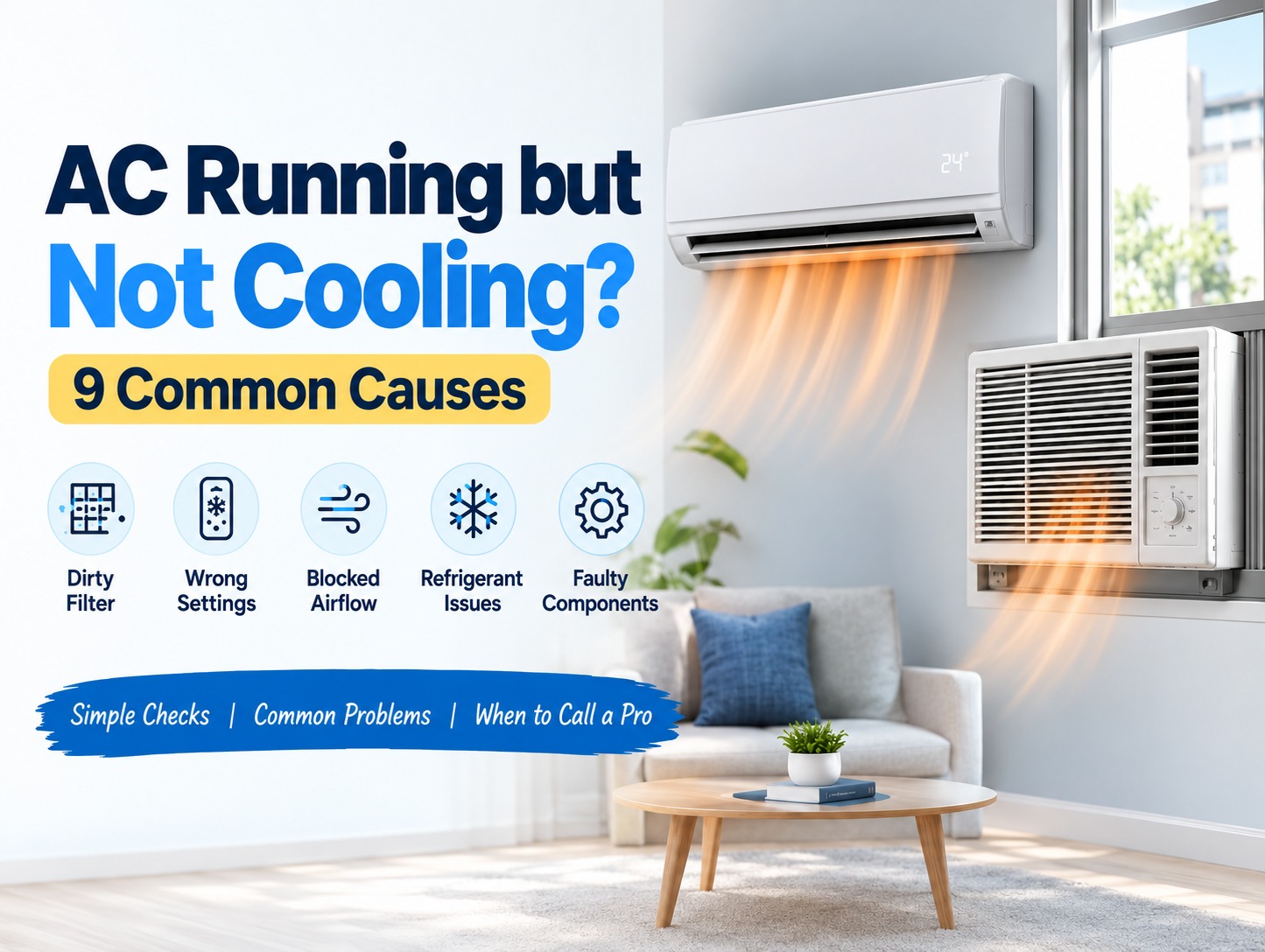
AC Running but Not Cooling? 9 Common Causes
Your AC is running and blowing air, but the room still feels warm. If your AC is running but not cooling, the cause could be a dirty filter, incorrect settings, restricted airflow, or an internal fault.
Split ACs have separate indoor and outdoor units, while window ACs combine their main components in one unit. In this guide, we cover nine common causes, safe troubleshooting steps for both types, and when to call a professional.
Why Is Your AC Running but Not Cooling?
An AC absorbs heat from indoor air and releases it outside. If airflow is restricted or the cooling system is not working properly, the fan may run without cooling the room effectively.
Common causes include dirty filters, incorrect settings, blocked airflow, refrigerant issues, frozen coils, and faulty components. Check the basic settings and accessible air filter first. If the problem persists, professional diagnosis may be needed.
Quick Troubleshooting: Match Your AC Symptoms to Possible Causes
| What you notice | Possible cause | What to do |
| Airflow is weak | Dirty filter or restricted airflow | Inspect the accessible filter and air outlet |
| Fan blows air, but it is not cool | Incorrect mode or cooling-system fault | Check Cool mode and the set temperature |
| Cooling becomes weaker over time | Dirty filter, icing, or another system problem | Inspect the filter and look for visible ice |
| AC runs for a long time without cooling the room | Heat load, capacity issue, or equipment fault | Check doors, windows, sunlight and room conditions |
| Water leaks or ice appears | Drainage, airflow, or refrigerant-related problem | Stop active cooling if ice forms and seek help if the issue persists |
| Unusual noise or electrical warning signs | Possible fan, electrical or mechanical fault | Stop using the unit if unsafe and contact a qualified technician |
These symptoms are clues, not definitive diagnoses. Several different faults can produce similar results.
Know 9 Reasons why AC Running but Not Cooling
1. Dirty or Clogged Air Filters
A dirty air filter is a common possible cause of poor AC cooling. Dust and debris can restrict airflow, preventing enough room air from passing through the indoor cooling coil.
This applies to both split ACs and window ACs. A clogged filter can reduce cooling performance and, under certain conditions, contribute to coil icing.
How to check and fix it:
- Switch off the AC before removing an accessible filter.
- Follow the manufacturer’s instructions to inspect and clean the filter.
- If the filter is reusable, clean it as directed and allow it to dry fully before reinstalling.
- Replace disposable filters when required.
- Check whether airflow improves after the filter is reinstalled correctly.
Do not operate the AC without its required filter. If cooling remains poor after cleaning, another problem may be responsible.
2. How to Fix AC Remote Temperature Settings
Sometimes the AC is working normally, but its operating mode is unsuitable for cooling.
In Fan mode, the AC may circulate room air without actively cooling it. Dry mode is designed mainly for humidity reduction and may not behave like Cool mode.
How to check and fix it:
- Select Cool mode, usually represented by a snowflake symbol.
- Set the temperature below the current room temperature.
- Choose a suitable fan speed.
- Check the remote batteries if the AC does not respond to commands.
- Allow the unit some time to operate and check whether cooling improves.
These steps apply to most split and window AC remotes, although the available settings vary by model. If the AC continues blowing warm air, check for other possible causes.
3. Blocked Airflow Around the Indoor Unit or AC Outlet
Even if the AC is producing cool air, the room may not cool evenly when airflow is obstructed.
For a split AC, curtains or furniture can block the indoor unit’s air outlet. For a window AC, blocked front vents or an obstructed return-air grille can affect air circulation.
How to check and fix it:
- Move furniture and curtains away from the air outlet.
- Make sure accessible air inlets and outlets are clear.
- Check whether the airflow feels weaker than usual.
- Confirm that the filter is correctly installed.
If airflow remains weak, the fan or internal airflow path may need professional inspection.
4. Dirty or Obstructed Outdoor Heat-Exchange Area
A split AC uses an outdoor unit to release heat from the room. If airflow around this unit is restricted or its heat-exchange surfaces are heavily contaminated, cooling performance may suffer.
A window AC also releases heat through the rear portion of its cabinet, which is generally positioned toward the outside. That area needs appropriate ventilation.
How to check and fix it:
- For a split AC, look for visible obstructions around the outdoor unit from a safe location.
- For a window AC, make sure the exterior ventilation area is not blocked.
- Keep the surrounding area clear according to the manufacturer’s recommendations.
- Do not open the cabinet or clean internal components while the unit is powered.
If the heat-exchange surfaces are heavily dirty or the unit behaves unusually, arrange a professional inspection. Never lean out of a window or attempt risky outdoor access to inspect an AC.
5. Low Refrigerant or Refrigerant Leak
Refrigerant transfers heat through the AC’s cooling circuit. If the system has insufficient refrigerant, cooling may become weak or stop working effectively.
Low refrigerant can be associated with a leak, but poor cooling does not automatically mean the AC needs a gas refill. Dirty filters, airflow restrictions, sensor problems and other faults can produce similar symptoms.
Possible warning signs include:
- Cooling that has gradually become weaker.
- Ice forming on parts of the system.
- A recurring cooling problem after previous servicing.
- Unusual sounds near refrigerant lines, although these can have other causes.
How to fix it:
Refrigerant diagnosis and handling should be performed by a qualified technician. If a leak is confirmed, it should be identified and repaired before the system is recharged as appropriate.
Do not attempt to open refrigerant lines or add refrigerant yourself.
6. Frozen Evaporator Coil
An evaporator coil absorbs heat from indoor air. Restricted airflow, refrigerant-related issues and other faults can cause the coil to become too cold, allowing ice to form.
A frozen coil can reduce airflow and prevent the AC from cooling the room properly.
How to identify the problem:
- Look for visible ice on accessible parts of the indoor unit or refrigerant lines.
- Notice whether airflow becomes weaker over time.
- Check whether water appears as ice melts.
- Observe whether cooling performance has deteriorated.
What to do:
Stop active cooling and follow the manufacturer’s instructions if ice appears. Do not scrape the ice or use sharp objects to remove it. If the problem recurs, arrange an inspection to identify the underlying cause.
7. Faulty Indoor Fan, Outdoor Fan or Internal Airflow Component
The fans move air across the heat-exchange surfaces. A faulty fan motor or another airflow-related component can interfere with heat transfer and cooling.
In a split AC, the indoor fan may continue blowing air even when the outdoor unit or cooling cycle has a problem. In a window AC, a fan or motor fault can also affect the unit’s ability to circulate air and transfer heat.
Possible signs include:
- Weak or inconsistent airflow.
- Grinding, rattling or unusual noises.
- The outdoor unit behaving differently from normal.
- Cooling that starts and stops unexpectedly.
Do not touch fan blades or open the unit to test its components. A technician can inspect the fan motor, controls and related parts safely.
8. Compressor, Capacitor or Electrical Component Problems
The compressor circulates refrigerant through the cooling system. A fault involving the compressor, capacitor, control board or another electrical component can prevent effective cooling.
An indoor fan that continues running does not prove that the compressor has failed. Proper testing is needed to identify the actual fault.
Warning signs may include unusual humming, repeated clicking, unexpected shutdowns or an outdoor unit that does not operate normally.
What should you do?
If you notice smoke, a burning smell or repeated circuit-breaker trips, stop using the AC and seek qualified assistance. Do not open electrical panels or attempt capacitor or compressor repairs yourself.
Professional diagnosis can help determine whether the problem involves a control, electrical component, compressor or another part of the system.
9. Incorrect AC Capacity or Excessive Room Heat
Sometimes the AC is operating but cannot cool the room effectively because its cooling capacity is insufficient for the heat entering the space.
Cooling requirements depend on several factors:
- Room area and ceiling height.
- Direct sunlight and window exposure.
- Insulation and air leakage.
- Number of occupants.
- Heat produced by appliances and electronics.
An undersized AC may run for long periods without achieving the desired temperature, particularly in hot weather.
If your AC has always struggled to cool the same room, have its capacity and the room’s cooling requirements assessed. If cooling has suddenly deteriorated, investigate a possible fault before assuming that the AC is undersized.
How to Fix by Remote Split AC Not Cooling but Fan Running:
A split AC has an indoor unit and a separate outdoor unit. The indoor fan can continue circulating air even when the cooling cycle is not working correctly.
If your split AC is running but not cooling, follow these safe checks.
Step 1: Check the Remote Settings
Confirm that the AC is set to Cool mode and the temperature is below the current room temperature. If the unit was accidentally switched to Fan mode, selecting Cool may resolve the problem.
Step 2: Inspect the Indoor Air Filter
A dirty filter can reduce airflow and cooling performance. Clean the accessible filter according to the manufacturer’s instructions and reinstall it correctly.
Step 3: Check the Indoor Air Outlet
Make sure curtains, furniture or other objects are not blocking the air outlet. Weak airflow that continues after cleaning the filter may indicate another problem.
Step 4: Observe the Outdoor Unit
From a safe location, look for visible obstructions and notice whether the outdoor unit appears to operate normally. Do not touch the fan, open the electrical compartment or attempt to test components.
If the indoor fan runs but cooling does not improve, the problem may involve the outdoor fan, compressor, refrigerant circuit, sensors or electrical controls.
Step 5: Look for Ice or Other Warning Signs
Visible ice, repeated water leakage, unusual noises or electrical symptoms can indicate a problem requiring professional attention. If ice forms, stop active cooling and follow the manufacturer’s guidance.
When to call a technician: If these checks do not restore cooling, professional diagnosis is recommended. Avoid assuming that every split AC cooling problem requires refrigerant refilling.
Window AC Not Cooling but Fan Is Running: How to Check and Fix It
A window AC houses its main components in one cabinet, so its cooling and airflow issues differ in some ways from those of a split AC.
If your window AC is blowing air but the room remains warm, work through the following checks.
Step 1: Check Cool Mode and Temperature
Make sure the unit is set to Cool rather than Fan mode. Set a suitable temperature below the current room temperature and check that the controls respond correctly.
Step 2: Clean the Accessible Air Filter
A clogged filter can restrict airflow through the unit. Switch off the AC and clean the filter according to the manufacturer’s instructions. Allow a washable filter to dry fully before reinstalling it.
Step 3: Check the Front Air Vents
Ensure that curtains, furniture or other objects are not blocking the front air outlet or return-air grille. Poor circulation can make the room feel warmer even when the AC is operating.
Step 4: Check Exterior Ventilation From a Safe Location
The rear section of a window AC releases heat outdoors. If its ventilation area is blocked, heat transfer may be affected.
Only inspect areas that are safely accessible. Do not lean out of a window, dismantle the cabinet or attempt to clean internal components while the AC is connected to power.
Step 5: Watch for Ice, Water or Unusual Noise
Ice formation, recurring water leakage, unusual humming or poor cooling after basic checks may indicate a deeper issue. Do not open the unit to inspect the compressor, capacitor or electrical wiring.
When to call a technician: If the window AC continues blowing warm air after checking the settings, filter and accessible airflow, arrange professional diagnosis. A technician can check the cooling circuit, fan system and electrical components as required.
What to Check Before Booking AC Repair
Before arranging a repair, make a note of the symptoms. This can help the technician understand the issue more quickly.
- Is the AC blowing warm air or no air at all?
- Did the problem start suddenly or develop gradually?
- Is the airflow weaker than usual?
- Is there visible ice or water leakage?
- Are there unusual noises or electrical warning signs?
- Does the AC struggle mainly during the hottest part of the day?
Check only accessible settings and components. Refrigerant handling, electrical testing and internal repairs should be performed by qualified professionals.
When Should You Call to Reboot it AC Repair Technician?
Consider professional diagnosis if your AC continues blowing warm air after basic checks, repeatedly develops ice, has unusually weak airflow or makes unfamiliar noises.
You should also seek qualified help for suspected refrigerant leaks, compressor problems and electrical faults. If you notice smoke, a burning smell or repeated circuit-breaker trips, stop using the unit and address the safety concern rather than continuing to troubleshoot it.
Prompt diagnosis can help identify the actual fault and avoid unnecessary part replacements.
Get Professional AC Repair in Kolkata
If your split AC or window AC is running but not cooling your room, the first step is to identify the cause rather than assume that a particular component needs replacement.
Reboot IT provides AC repair and servicing support in Kolkata. If basic troubleshooting does not resolve your cooling problem, contact the team to discuss your symptoms and confirm the available service options.
Visit our AC Repair in Kolkata service page to learn more.
Frequently Asked Questions
1. Why is my AC running but not cooling the room?
Possible causes include dirty filters, incorrect settings, restricted airflow, a dirty heat-exchange area, refrigerant problems, frozen coils, fan faults, electrical issues or insufficient cooling capacity. The actual cause depends on the symptoms and the condition of the unit.
2. Why is my AC not cooling but the fan is running?
The fan may be circulating air while the cooling cycle is not working effectively. Check Cool mode and the accessible air filter first. If the problem persists, a technician may need to inspect the cooling system.
3. Why is my split AC not cooling but the fan is running?
The indoor fan may continue operating despite a problem with the outdoor unit, refrigerant circuit, sensors or compressor-related components. Check the remote settings and filter, then arrange professional diagnosis if cooling does not improve.
4. Why is my window AC running but not cooling?
Possible causes include incorrect settings, a dirty filter, blocked airflow, restricted exterior ventilation or an internal component fault. Check accessible settings and the filter first. Do not dismantle the unit to investigate internal components.
5. Can a dirty AC filter cause poor cooling?
Yes. A clogged filter can restrict airflow and reduce cooling performance. Inspect and clean or replace the filter according to the manufacturer’s instructions.
6. Does an AC need a gas refill if it is not cooling?
Not necessarily. Poor cooling can result from several issues, including dirty filters, airflow restrictions, sensor faults or refrigerant problems. A technician should diagnose the actual cause and check for a leak where necessary before recharging refrigerant.
7. Should I turn off my AC if ice forms on it?
Stop active cooling and follow the manufacturer’s instructions if ice forms. Do not scrape the ice or attempt internal repairs. If the icing returns, arrange professional diagnosis.
8. How long should I wait after changing the AC settings?
Allow the unit some time to operate after selecting Cool mode and a suitable temperature. The time needed to cool the room depends on its size, heat load, outdoor conditions and the AC’s condition. If cooling does not improve, investigate other causes.
9. When should I call an AC repair technician?
Contact a technician if basic checks do not restore cooling, the problem repeatedly returns, or you notice ice, suspected refrigerant leakage, unusual noises or component faults. For smoke, a burning smell or repeated breaker trips, stop using the unit and seek qualified assistance.